



Engineering
Vercel vs AWS for a SaaS MVP (2026)
Nothing kills momentum on an MVP like a hosting decision that turns into an infrastructure project. Founders arrive convinced they need to "do it properly" on AWS — VPCs, load balancers, an IAM policy nobody fully understands — and lose two weeks to plumbing before a single user sees the product. Vercel and AWS sit at opposite ends of that trade-off: one hides the infrastructure so you ship today, the other hands you the whole toolbox for when today isn't the problem. Here's how we'd choose in 2026.
Should you host your SaaS MVP on Vercel or AWS?
For most SaaS MVPs in 2026, host on Vercel — it deploys your Next.js app in minutes, scales itself, and lets a small team ship without a dedicated ops person. Choose AWS when your product has heavy backend compute, long-running jobs, strict data-residency or compliance rules, or you're already at a scale where the bill justifies running your own infrastructure. For a pre-revenue MVP racing to real users, Vercel almost always wins; the reasons to pick AWS are real but specific.
The honest framing: this isn't Vercel or AWS forever. It's Vercel to get to market, AWS when you outgrow it — and most MVPs are nowhere near outgrowing it on launch day. Vercel even runs on AWS underneath, so "moving to AWS later" is an evolution, not a betrayal of an early choice.
What's the real difference?
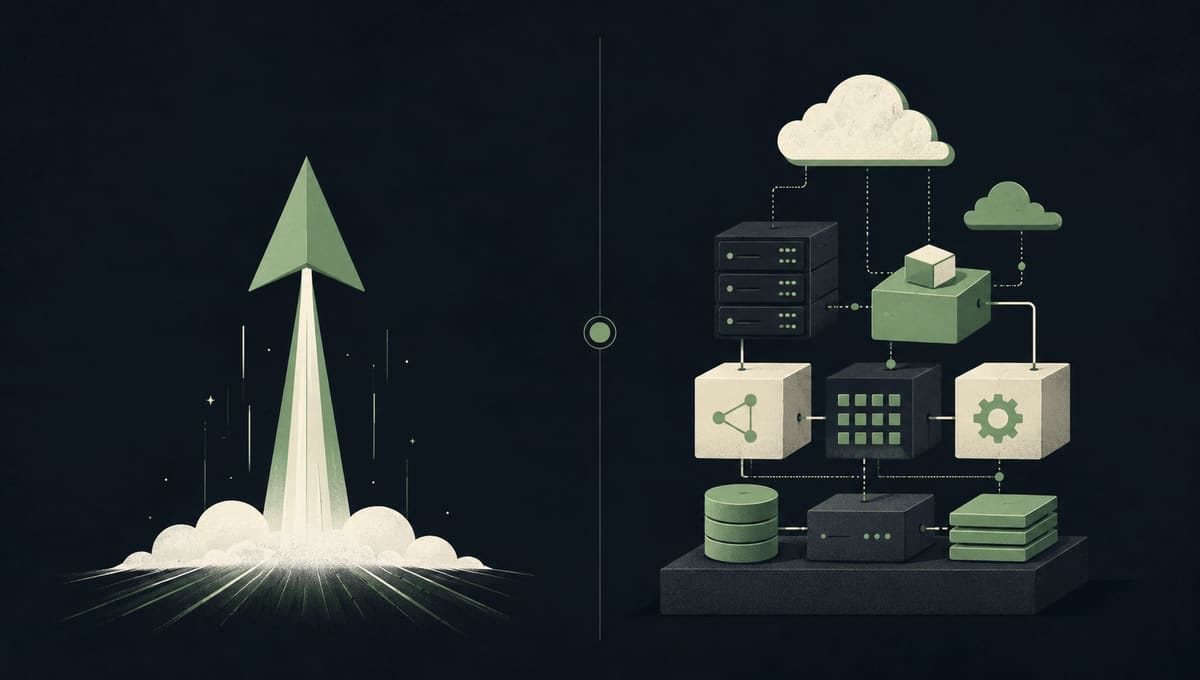
Vercel is a platform-as-a-service built around frontend frameworks — you push code, it builds and serves it on a global edge network, and the servers, scaling and CDN are invisible. AWS is the raw cloud: hundreds of primitives (EC2, Lambda, RDS, S3, ECS) you assemble yourself into whatever you need. One optimises for time; the other for control.
| Vercel | AWS | |
|---|---|---|
| Setup effort | Minutes — connect repo, deploy | Days — VPC, IAM, CI/CD, infra-as-code |
| Pricing model | Flat tiers + usage, predictable | Pure usage, granular, harder to forecast |
| Scaling | Automatic, zero config | Automatic but you configure it |
| Backend / compute | Serverless functions (timeout limits) | Anything — EC2, Fargate, long jobs, GPUs |
| Cold starts | Possible on serverless functions | Tunable (provisioned concurrency, containers) |
| Compliance / regions | Limited region control | Full control — data residency, HIPAA, gov |
| Ops burden | Near zero | Real — needs someone who knows AWS |
| When it wins | Speed-to-ship an MVP | Heavy backend, scale, strict compliance |
The row that matters most for an MVP is ops burden. AWS gives you every capability, but capability you have to operate is a cost, not a gift. Someone has to own the account, patch things, read CloudWatch at 2am, and keep the IAM policies from drifting into a security hole. On Vercel, that someone is Vercel.
When do you outgrow Vercel?
Vercel is excellent right up until you hit one of a small, concrete set of walls. These are the signals — and until you meet one, staying is the right call, not a compromise.
- Long-running or heavy compute. Vercel's serverless functions have execution timeouts. A single API call or LLM request is fine; a 20-minute video transcode, a large batch export, or a chain of model calls over a big document isn't. This is the most common reason our clients graduate work off Vercel — and often you move just that workload to AWS (a queue plus Fargate or Lambda) while the web app stays put.
- Persistent connections at scale. WebSockets, long-lived streams, and stateful realtime servers fit AWS (or a dedicated service) far better than serverless functions.
- Strict compliance or data residency. If a regulator or enterprise customer requires your data to live in a specific region, inside a private network, or under HIPAA/SOC 2 controls you administer, AWS gives you the region and network control Vercel doesn't expose.
- Cost at real scale. High-bandwidth or high-invocation apps can cost meaningfully more on Vercel's managed pricing than on equivalent raw AWS once you're past hobby traffic. At MVP scale this gap is noise; at millions of requests it's a line item worth engineering against.
- A large non-web backend. If most of your product is background workers, data pipelines, or services that aren't a Next.js app, you're using Vercel for the small part and needing AWS for the big part anyway.
Notice the pattern: none of these are launch-day problems for a typical B2B SaaS. They arrive with traction, and traction is exactly when you can afford the migration. This mirrors the "start on API routes, split to a service later" logic from our SaaS MVP tech stack guide — the same instinct applied to hosting.
Which is cheaper?
At MVP scale Vercel is effectively free-to-cheap and easier to predict; at large scale raw AWS is cheaper per unit but only if you have the expertise to run it efficiently. The honest answer is that "cheaper" flips depending on where you are on the curve.
| Vercel | AWS | |
|---|---|---|
| MVP / pre-revenue | Free tier covers it | Free tier exists but needs setup |
| Small paid app | ~$20/mo Pro, predictable | Often $20–80 across services |
| Cost predictability | High — flat + capped usage | Lower — many metered dimensions |
| At heavy scale | Can get expensive (bandwidth) | Cheaper per unit, if run well |
| Hidden cost | Overage on bandwidth/functions | Your engineer's time operating it |
The trap on both sides is a hidden cost. On Vercel it's usage overages — bandwidth and function invocations that spike with a viral moment or a badly scoped cron. On AWS it's the one that never shows on the invoice: engineering time. A "cheaper" AWS bill that consumes a day a week of a developer's attention isn't cheaper — you've just moved the cost off the card statement and onto your roadmap. For a small team, that's usually the more expensive currency.
This predictability is why we quote fixed-price MVP builds rather than open-ended infrastructure work — flat, known hosting costs make the whole number knowable up front. If you're modelling the full picture, our UK MVP cost breakdown covers where the money actually goes, and hosting is a smaller slice of it than most founders expect.
Our default
For the SaaS MVPs we build — Next.js apps with auth, billing, and relational data — we host on Vercel almost every time. It's the same logic behind our whole recommended MVP stack: pick the boring, well-supported option that gets you to paying users fastest without an ops hire. Vercel and Next.js are the same company's products, so the integration is seamless — preview deploys per pull request, automatic HTTPS, a global CDN, zero server config. A two-person team can ship and run a production app on it with no DevOps specialist, and that's the whole point of an MVP.
But we're honest with clients about the exit ramp, because pretending Vercel scales to everything would set them up for a painful surprise. The migration path is deliberately gentle:
- Start fully on Vercel. Web app, API routes, the lot. Ship, get users, learn what the product actually needs.
- Peel off the heavy workload first. When a long-running job or a compute-heavy feature hits the serverless timeout, move that one thing to AWS — a queue (SQS or a managed alternative) feeding a container on Fargate, or a Lambda for burstier work — while the web app stays on Vercel. This solves the actual bottleneck without a rewrite.
- Move the web app only if you have to. Data-residency rules, a contractual requirement, or genuine cost pressure at scale are the reasons to relocate the front door to AWS (Amplify, ECS, or CloudFront + Lambda). Because your database is already portable Postgres and your app is standard Next.js, this is a project measured in days, not a ground-up rebuild.
When a build has hard compliance requirements or a compute-heavy core from day one — fintech with data-residency rules, a product whose main loop is video processing or model training — we start on AWS instead and accept the slower setup, because there the control earns its keep. That work is a service we offer directly: DevOps and cloud infrastructure for teams that have genuinely outgrown the managed-platform stage.
The backend language choice interacts with this too — Node fits Vercel's serverless model natively, while a Python or Django backend often leans toward AWS or a container host. We weigh that in Django vs Node.js for a SaaS backend. And the same start-managed-then-graduate reasoning applies to your database, as we cover in Supabase vs Firebase for a SaaS MVP.
Frequently asked questions
Is Vercel just AWS with a markup?
Partly — Vercel runs on AWS infrastructure and charges a premium for the developer experience, but calling it "AWS with a markup" undersells what you're actually buying. You're paying for the parts you'd otherwise build and operate yourself: automatic scaling, a global edge network, per-branch preview deploys, zero-config CI/CD, and no account to secure or servers to patch. For a small team, that markup is almost always cheaper than the engineering time it replaces. At large scale the maths can invert — high-bandwidth apps get meaningfully cheaper on raw AWS — which is exactly the point at which moving is worth the effort. Below that scale, the premium buys you speed, and speed is the scarcest resource on an MVP.
Can you move from Vercel to AWS later without a rewrite?
Mostly yes — if you built on standard Next.js and portable Postgres, moving is a reconfiguration, not a rewrite. Your application code doesn't change; what changes is where it's built and served. You'd typically move the heavy or non-web workloads first (a queue and a container on AWS) while the web app stays on Vercel, and relocate the front-end host only if compliance or cost demands it. The things that make a migration painful — proprietary APIs, framework lock-in, a database with no clean export — are the same things we steer clients away from at the start precisely so this door stays open. Start on Vercel, keep your foundations portable, and the migration is a planned week's work rather than a crisis.
Does AWS make sense for a solo founder or tiny team?
Rarely at the MVP stage — AWS's power comes with an operational tax that a solo founder usually can't afford to pay in time. Unless you already know AWS well or have a hard requirement (compliance, heavy compute) that forces your hand, the hours you'd spend on VPCs, IAM, and CI/CD pipelines are hours not spent on the product your customers actually care about. A managed platform like Vercel lets one person run a production app, which is the whole game before product-market fit. Reach for AWS when you have either the expertise in-house or a specific need that genuinely requires it — not because it feels more "serious."
What about compliance — can't you be compliant on Vercel?
You can meet many requirements on Vercel, but AWS gives you the region control, network isolation, and administrable controls that strict regimes demand. If your customers need data pinned to a specific country, a private network boundary, or certifications you administer directly (certain HIPAA, gov, or enterprise-security requirements), AWS exposes the knobs to satisfy an auditor in ways a managed platform deliberately abstracts away. If your compliance needs are more standard — a UK/EU B2B SaaS handling ordinary business data — Vercel plus a well-chosen database region is usually enough to launch. Let the actual regulatory requirement, not a general sense of caution, decide — our guide to UK GDPR for SaaS startups covers which regions avoid transfer paperwork.
The bottom line
Ask where you are on the curve. Racing to launch an MVP → Vercel: minutes to deploy, scales itself, no ops hire, predictable cost. Heavy backend compute, strict compliance, or serious scale → AWS: total control over regions, long-running jobs, and per-unit cost, at the price of real operational work. For most SaaS MVPs the right move is Vercel now and AWS later — and "later" only arrives with the kind of traction that pays for the move.
Whichever you pick, hosting is a means to shipping, not the point. Choose the option that gets your product in front of real users fastest without a rewrite waiting six months out.
Want your hosting chosen around your product's real needs, not a default? Book a free scoping call — we'll map the right infrastructure to your build and quote it fixed-price.
Keep reading



Leave a comment