



Process
UK GDPR for SaaS Startups: A Practical Guide
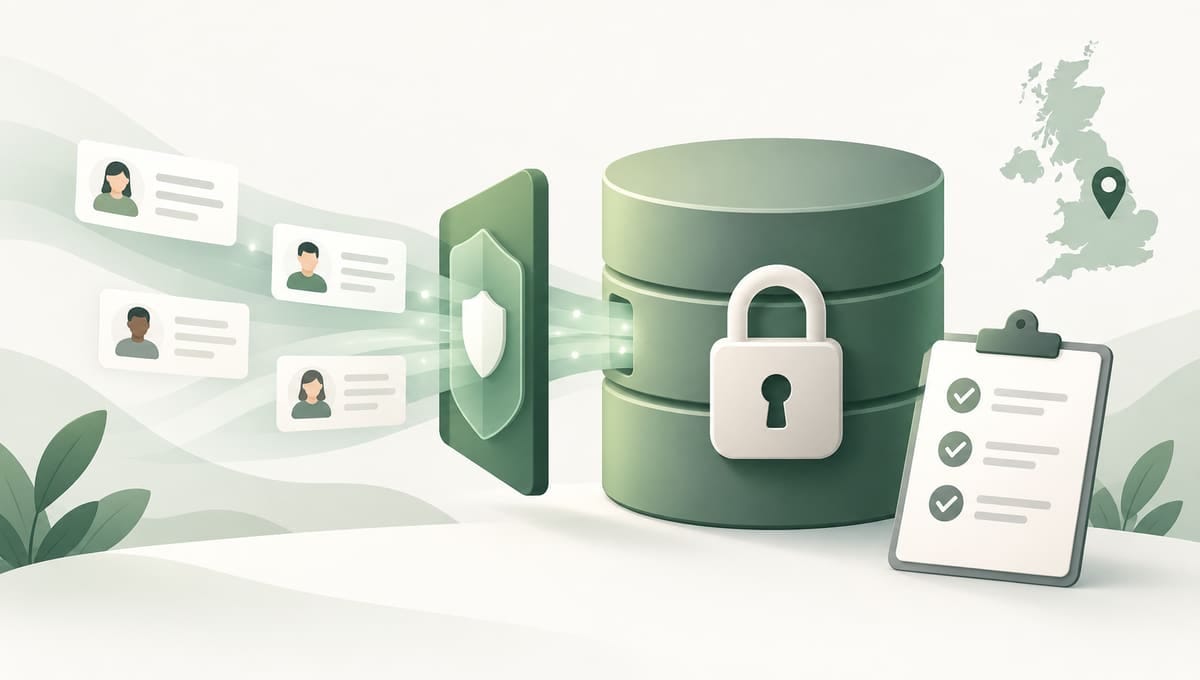
Most founders meet UK GDPR twice: pasting a privacy policy template into the footer, then answering an enterprise prospect's questionnaire about where the data lives and how fast you can delete it. By then, the answers are baked into the schema. Compliance is mostly engineering wearing a legal hat — and it's cheapest before the first table exists.
This is practical guidance, not legal advice. For anything high-stakes, take advice from a data protection specialist and check the ICO's current guidance — the Data (Use and Access) Act 2025 is amending parts of UK GDPR and PECR in stages.
How do you make a SaaS product GDPR-compliant in the UK?
Map the personal data you collect and why, give every use a lawful basis, explain it in a plain-English privacy notice, build security, retention and deletion into the product from the first sprint, and put a DPA in place with every vendor that touches the data. The rules come from UK GDPR, the Data Protection Act 2018 and PECR (cookies and e-marketing), enforced by the Information Commissioner's Office (ICO).
Most SaaS processing rests on one of two lawful bases: contract — you need the data to provide the service — or, where the user's employer is your customer, legitimate interests with a short written balancing test. Keep consent for optional extras: it can be withdrawn at any time, so it can't underpin data the product needs.
You're the controller for your own users' data, but usually a processor for data B2B customers load into your product — so have a DPA ready for them. Your own DPA with a development agency is covered in our software development contract checklist.
The UK GDPR checklist for a SaaS build
| Area | What to do | When in the build |
|---|---|---|
| Data map | Each type of personal data: purpose, lawful basis, location, retention | Discovery |
| Privacy notice | What you collect, why, on what basis, how long, who receives it, rights | Before the first real sign-up |
| Encryption | TLS everywhere; encryption at rest, including backups | Infrastructure setup |
| Access control | Least privilege, MFA, an audit log of access to personal data | Sprint one, with auth |
| Retention and deletion | A period per data type, enforced by a scheduled job | With the schema |
| Rights requests | An admin data export and a delete-account flow | Before launch |
| Breach response | A runbook with an owner and the 72-hour ICO clock | Before launch |
| Vendors and transfers | A DPA with each sub-processor — hosting, email, analytics, LLM APIs — and UK or EEA regions where possible | As each vendor is chosen |
| Cookies | No non-essential cookies before opt-in | Before the marketing site launches |
| ICO fee | Pay the annual fee unless exempt | Before launch |
None of it is exotic. It only gets expensive after launch, when "delete my account" means untangling a year of foreign keys.
What does privacy by design mean in practice?
It means privacy is a property of the codebase, not a page on the website: the defaults protect users, and the protective path is the easy one. In practice, five habits:
- Collect less. Every field needs a reason, and personal data stays out of logs and error reports.
- Private by default. New features ship with the most protective setting: profiles private, sharing opt-in.
- Encrypt in transit and at rest. UK GDPR requires security appropriate to the risk and names encryption as an example.
- Least privilege, logged. MFA on every admin account, and an audit log of who viewed or exported personal data, support staff included. A mature auth provider does much of this — see Clerk vs Auth0 vs NextAuth.
- Make deletion real. A
deleted_atflag isn't deletion. Hard deletes should reach your email platform, CRM and analytics, with backups ageing out on a fixed rotation.
In a multi-tenant product, enforce tenant isolation in the database rather than trusting every query — see multi-tenant SaaS architecture. And if the processing is likely to be high-risk — health data, large-scale tracking, a product aimed at children — you need a data protection impact assessment (DPIA) first, ideally with specialist help.
How do you handle a data subject access request?
Recognise it, confirm who's asking, gather everything you hold on them and respond within one month — free of charge in almost all cases. No form or magic words are needed: "send me everything you have on me" in a support chat counts. Complex or numerous requests can be extended by up to two further months, if you tell the person within the first.
They get a copy of their data plus supporting details — purposes, recipients, retention — mostly already in your privacy notice. Search support tickets, email and internal chat too, and redact other people's data. An admin export to JSON or CSV turns a two-day scramble into a ten-minute job.
If the data belongs to a B2B customer's account, you're their processor: pass the request on promptly and help them answer it. Erasure runs on the same clock but isn't absolute — you can keep what the law requires, such as invoices. For backups, the ICO's approach is pragmatic: put the data beyond use, let it age out, and say so in your response.
What do you do after a data breach?
Contain it, assess the risk to the people affected and, if it's reportable, tell the ICO without undue delay and within 72 hours of becoming aware of it — 72 hours, not three working days. A misdirected email, a public storage bucket or a bug showing one customer another's data all count. Report unless the breach is unlikely to result in a risk to people's rights and freedoms; if the risk is high, you'll usually need to tell those affected too. As a processor, tell your customer without undue delay. Record every breach, reported or not, and write the runbook before launch — nobody writes a good one at 2am.
Where should you host UK customer data?
In a UK or EEA region by default — not because the law demands it, but because it avoids transfer paperwork and answers the first question enterprise buyers ask. UK GDPR doesn't require UK hosting; it requires transfers outside the UK to be covered. The EEA is covered by UK adequacy regulations, so Dublin or Frankfurt need no extra paperwork. A US region needs a mechanism: the UK-US data bridge for certified companies, or the International Data Transfer Agreement (IDTA) or UK Addendum to the EU's standard contractual clauses, backed by a transfer risk assessment.
Two catches. A region pins where data rests, not who can reach it — vendor support staff abroad can still mean a transfer. And logs, email and error tracking live wherever those vendors run.
Contractual residency requirements are a good reason to start on AWS, as we explain in Vercel vs AWS for a SaaS MVP. Region pinning, encrypted backups and access logging are the kind of setup our DevOps and cloud infrastructure team handles.
Your launch-readiness checklist
Copy this and tick it off before launch:
- Data map: what we hold, why, on what basis, where, for how long
- Privacy notice linked from sign-up and the footer
- ICO fee paid, or exemption confirmed
- DPA with every sub-processor; customer-facing DPA ready (B2B)
- HTTPS everywhere; encryption at rest, including backups
- MFA on every admin account; audit log of data access
- Retention enforced; export and deletion tested end to end
- Breach runbook with an owner and the 72-hour clock
- No non-essential cookies before consent
Frequently asked questions
Do I need a Data Protection Officer?
Usually not — early-stage startups rarely meet the conditions that make one mandatory. You need a DPO if you're a public authority, or your core activities involve large-scale, regular and systematic monitoring of people, or large-scale processing of special category or criminal offence data. Someone should still own data protection, and a DPO appointed voluntarily is held to the same legal requirements, so many startups name a privacy lead instead.
Do I need to pay the ICO data protection fee?
Almost certainly — if your product processes personal data, you pay the annual fee unless a narrow exemption applies. Fees are tiered by size; the lowest tier, which covers most early startups, costs tens of pounds a year. Pay before you process real users' data, renew annually, and use the ICO's online self-assessment if you're unsure.
Can I use US-based tools like analytics or email providers?
Yes, if each is covered by a DPA, the transfer rests on a recognised mechanism, and your privacy notice discloses it. For US vendors that usually means the UK-US data bridge, or the IDTA or UK Addendum in their DPA — check which. Send only what they need: an analytics event rarely needs an email address.
Do I need a cookie banner?
Only if you use cookies or similar technologies that aren't strictly necessary. Login sessions and security are exempt; advertising pixels and most third-party tracking are not. Where consent is needed, it must be opt-in and given before anything is set, and refusing should be as easy as accepting. The Data (Use and Access) Act 2025 is changing some of these rules in stages, so check the ICO's current guidance first.
The bottom line
It comes down to early engineering decisions: collect less, encrypt everything, log access, make deletion real, host in the UK or EEA, and put every vendor under a DPA. Made in the first sprint, they cost days — see what a fixed-price build costs. Retrofitted, they become a migration.
Want the privacy baseline built in from day one? Book a free scoping call and we'll factor your data flows into the scope.
Keep reading


Leave a comment