
Process
Cyber Essentials for SaaS Startups (UK Guide)
The question usually arrives in a supplier questionnaire, somewhere between "where is customer data hosted?" and "do you have a DPA?": do you hold a current Cyber Essentials certificate? Most guides to the scheme picture an office with a router and a server cupboard. Your company is a handful of laptops and thirty SaaS logins — and since April 2026, those logins are where the scheme looks hardest.
This is general guidance, not legal or certification advice.
Does a SaaS startup need Cyber Essentials?
No law requires it, but you need it as soon as you bid for UK central government or NHS work involving personal data or ICT systems, or sell to an enterprise whose supplier questionnaire asks for it. For a cloud-first team it's cheap — £320 + VAT for under ten staff — and mostly configuration.
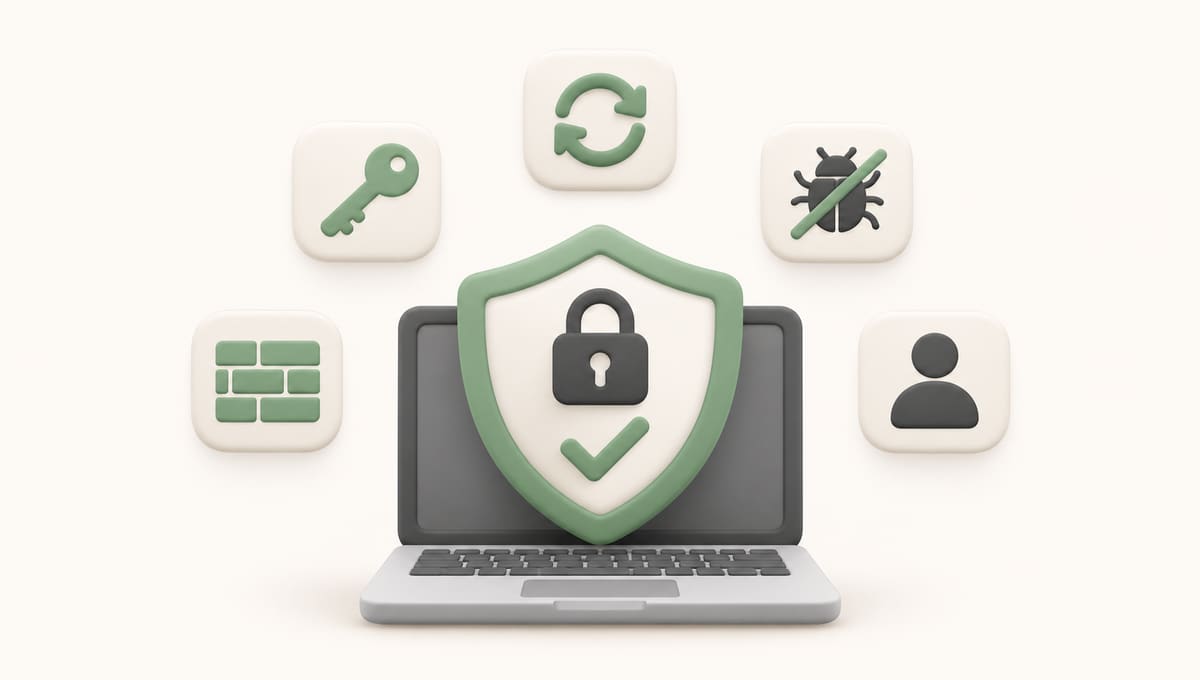
Cyber Essentials is the UK government-backed security baseline, designed by the National Cyber Security Centre (NCSC) and delivered by IASME, its official delivery partner, through licensed certification bodies. It checks five technical controls: firewalls, secure configuration, security update management, user access control and malware protection.
Cyber Essentials is a verified self-assessment: you answer an online question set, a board member signs off the answers, and a certification body's assessor marks them. Cyber Essentials Plus adds a technical audit: an assessor scans your public IP addresses, checks sample devices for missing patches and malware protection, and watches users log in to every cloud service to confirm MFA. Both renew annually, and both cover much of the security work in our UK GDPR guide.
How does Cyber Essentials compare with ISO 27001 and SOC 2?
| Cyber Essentials | Cyber Essentials Plus | ISO 27001 | SOC 2 | |
|---|---|---|---|---|
| What it is | Self-assessment, marked by a certification body | Same controls, plus a technical audit of your systems | A certified information security management system | A CPA firm's report against the AICPA Trust Services Criteria |
| Who asks for it | UK central government, NHS bodies, UK supplier questionnaires | Higher-risk public contracts, some enterprise buyers | Large enterprises, regulated and international buyers | Mostly US buyers |
| Effort for a small SaaS team | Days to a few weeks | Basic, plus audit prep and fixes | Months, then ongoing upkeep | Months; Type II covers an observation period |
| Fee | £320–£600 + VAT by headcount | Quoted | Quoted | Quoted |
| Renewal | Every 12 months | Every 12 months | Three-year cycle, yearly surveillance audits | A fresh report, usually yearly |
Cyber Essentials isn't a lighter ISO 27001: Cabinet Office guidance says ISO 27001 certification doesn't automatically meet it. For a UK startup, do Cyber Essentials first — it's cheap, quick, and the work carries into ISO 27001 or SOC 2 later.
When do UK buyers require Cyber Essentials?
Central government departments, their agencies and non-departmental public bodies, and NHS bodies must make suppliers demonstrate Cyber Essentials controls — in practice, a Cyber Essentials or Plus certificate — on contracts involving citizens' or officials' personal data, or ICT systems that store or process OFFICIAL data. The rule is Procurement Policy Note 014 (PPN 014), published by the Cabinet Office in February 2025, replacing PPN 09/14 and PPN 09/23.
- Evidence comes before data. You need the certificate, or proof of equivalent controls, before contract award — so certify before the tender.
- It renews with the contract. Suppliers must renew every year for the life of the contract.
- "Equivalent" is the slow road. It normally needs verifying by an independent third party.
PPN 014 doesn't bind councils, though IASME notes a growing number of local government contracts ask. Enterprise pressure comes through supply chains: more than 230 organisations have signed the government's Cyber Resilience Pledge, committing to a risk-based approach to requiring Cyber Essentials from suppliers.
How much does Cyber Essentials cost?
The basic certificate costs £320 + VAT for up to nine employees, rising to £600 + VAT for 250 or more, and until 31 March 2027 eligible SMEs not certified in the last four years can get 75% off, paying £80 to £125 + VAT. Cyber Essentials Plus has no published price: certification bodies quote it on the size and complexity of your network.
| Employees | Standard fee | With the 75% First Step Fund discount |
|---|---|---|
| 0–9 (micro) | £320 + VAT | £80 + VAT |
| 10–49 (small) | £440 + VAT | £110 + VAT |
| 50–249 (medium) | £500 + VAT | £125 + VAT |
| 250+ (large) | £600 + VAT | Not eligible |
These are IASME's published fees as of November 2026, and they can change — check IASME's Cyber Essentials page before you budget. The discount is the government's First Step Fund, launched on 3 November 2026: £2.4m, first come, first served, so it may run out early.
The fee is the smallest cost: the real effort is remediation before you buy. An assessor aims to mark your answers within three working days. Fail, and you get two working days to fix simple issues and resubmit free; after that you pay again.
The free cyber insurance. A UK-domiciled organisation with turnover under £20m that certifies its whole organisation can opt in to free cyber liability insurance: a £25,000 limit, a £1,000 excess and a 24-hour incident helpline. Fine for a small incident; no substitute for proper cover.
What makes SaaS teams fail Cyber Essentials?
Under the rules in force since 27 April 2026, missing MFA on any cloud service that offers it, or a high or critical update left unpatched beyond 14 days, fails the assessment outright — as unsupported software already did. The auto-fails came with v3.3 of the NCSC's Requirements for IT Infrastructure and IASME's "Danzell" question set, replacing v3.2 and "Willow".
What catches SaaS teams out:
- MFA means every cloud service, even as a paid add-on. If a service offers it, every user and admin must use it. If it has none of its own but can sign in through Google Workspace or Microsoft 365, that link must be configured.
- Fourteen days covers apps too. Operating systems, firmware and applications, extensions included — any fix rated critical or high, CVSS v3 7 or above, or not rated at all.
- Admins need a second account. Cloud admin work must use a separate account, so reading email in your Workspace super-admin account fails that question.
- Unsupported means on the day. Windows 10 needs Microsoft's Extended Security Updates; a Mac that no longer gets security updates has to go.
- Phones are in scope. Any phone with work email or Slack is in, personal or not; only devices used solely for calls, texts and MFA apps are out.
- Your LinkedIn page counts. Social media accounts are cloud services too.
What's in scope for a cloud-first SaaS team?
Every cloud service that stores or processes your organisation's data — IaaS, PaaS and SaaS — is in scope, with every device that accesses it; the bespoke code of your own product is not. Version 3.3 says cloud services cannot be excluded, and a scope without end-user devices isn't acceptable.
Cloud changes who implements each control, not whether it applies. In the NCSC's shared-responsibility model, a SaaS provider handles firewalls, patching and malware protection; on PaaS such as AWS Lambda you share configuration and updates; on IaaS such as Amazon EC2 you share the other four. User access control is yours alone in every case.
Your own app's bespoke code is out of scope (the requirements point developers to the government's Software Security Code of Practice), but buyers will still probe it — tenant isolation is a favourite, as covered in multi-tenant SaaS architecture. Home routers you didn't supply are out, so laptop firewalls must be on. And accounts your company owns stay in scope when a contractor uses them.
How do you pass Cyber Essentials with a modern SaaS stack?
Enforce MFA at the organisation level in every console, give admins separate accounts, let every device update itself and write down how people join and leave.
- Google Workspace or Microsoft 365. Enforce 2-Step Verification in the Google Admin console, or turn on security defaults or a Conditional Access policy requiring MFA in Microsoft Entra ID. Create a dedicated admin account and take admin rights off everyday accounts.
- GitHub. Require two-factor authentication for the organisation, review owners, and remove former contractors and stale collaborators.
- AWS. MFA on the root user, then stop using it; named access through IAM Identity Center. Security groups are your firewall: block unauthenticated inbound traffic and document a business reason for every open port.
- Vercel and Supabase. Vercel teams can switch on Two-Factor Authentication Enforcement in team settings, and every Vercel user must set up an authenticator app by 20 January 2027. Supabase's "Require MFA to access organization" needs a Pro, Team or Enterprise plan; on Free, check each member's own MFA.
- Everything else. Stripe, Slack, your domain registrar: MFA everywhere, and a list, because the question set asks for every cloud service.
- Devices. A supported OS with automatic updates on every laptop and phone; each laptop's built-in firewall on (on a Mac: System Settings, Network, Firewall) and anti-malware active; a lock after no more than 10 failed attempts; daily work in a standard account, not an admin one.
- Passwords. A company password manager, and no forced expiry or complexity rules — the scheme tells you not to enforce them.
- Joiners and leavers. Approval before anyone gets an account, a reviewed list of admins, and an offboarding checklist that disables every account the day someone leaves.
How long does a Cyber Essentials certificate last?
A certificate is valid for 12 months from issue, and you renew by answering the full, current question set again; Cyber Essentials Plus must be completed within three months of your basic certificate.
The signed declaration now commits you to keeping every control in place all year, not just on assessment day; on a government contract, renew early. For Plus, finish the self-assessment first — since April 2026 you can't change those answers once testing starts — and if sampled devices fail the patch checks, the retest adds a fresh random sample, and a second failure revokes your basic certificate too.
Our default: build so your company can pass
We can't sit the assessment for you: the question set wants the person responsible for your IT to be your own, not an outsourced provider's. We build so the product and its accounts are ready for it — the baseline our DevOps and cloud infrastructure work sets up:
- Your accounts, from day one. GitHub, Vercel, Supabase, Stripe and Clerk are created in your company's name, with our engineers as named members you remove at handover — see our software development contract checklist.
- MFA on every admin account from the first commit, enforced at team level wherever the vendor allows.
- Least privilege. Named accounts, no shared logins, production access only for those who need it.
- Managed services over servers. Our default stack — Next.js, Postgres (often on Supabase), Clerk, Stripe and Resend on Vercel — keeps you off servers you'd patch yourself; the reasoning is in our SaaS MVP tech stack guide.
- Patched dependencies. Automated dependency updates and security alerts on every repository.
When a buyer needs EC2 or similar, we add automated patching and documented security groups. Investors check the same habits in technical due diligence.
Frequently asked questions
Is Cyber Essentials a legal requirement in the UK?
No — no UK law requires it; it becomes mandatory through contracts. PPN 014 makes it standard on many central government and NHS contracts, and IASME notes it's required across the Ministry of Defence supply chain for suppliers handling defence information. Private buyers add it to supplier terms.
Is the basic certificate enough, or do we need Plus?
Start with the basic certificate unless a tender or contract names Plus. Government guidance says Plus should be used where the risk of cyber threats is higher, and it needs the basic certificate first. If a deal requires Plus, book the audit before you certify: it must be done within three months.
Does Cyber Essentials make us UK GDPR compliant?
No, but it covers much of the account and device security UK GDPR expects. UK GDPR requires security appropriate to the risk, and MFA, patching and access control are exactly that. Lawful basis, retention, access requests and breach reporting are separate — see our UK GDPR guide.
Want a SaaS product that's Cyber Essentials-ready from day one?
We build SaaS MVPs for UK founders with MFA, least-privilege access and client-owned accounts set up in the first sprint, so certification starts from a clean baseline, not a clean-up. Book a free scoping call and we'll factor your buyers' security requirements into the scope, then quote the build fixed-price.
Keep reading



Leave a comment