

Process
How to Build an AI SaaS MVP (2026 Guide)
Most AI SaaS MVPs fail the same way. The demo shines on five hand-picked examples, then customers bring messy, real inputs and the output falls apart. The model was never the hard part: what makes or breaks an AI product is knowing what "good" looks like, measuring it, and keeping each user's model bill below their subscription.
How do you build an AI SaaS MVP?
Define the one job the AI does, build an evaluation set of real examples before you build the product, prove a frontier model can pass it, then wrap that model in a normal SaaS with background jobs, structured outputs, guardrails, logging and per-user cost limits. Budget 10–14 weeks for a production AI MVP; a narrow validation build can ship in 2–4.
Order matters more than tools. Founders who build the app first often learn in week ten that the model can't do the job. Prove the AI on your data first; the rest is familiar work.
Is an AI-native product different from a SaaS with AI features?
Yes. In an AI-native product the model is the core workflow: if its output is wrong, the product is wrong. A SaaS with AI features works without it, and the AI speeds up one step; see when to add AI features to your SaaS MVP. This guide is for the first kind.
| SaaS with AI features | AI-native SaaS | |
|---|---|---|
| Role of the model | Speeds up one step | Is the core workflow |
| If the model fails | A feature degrades | The product fails |
| Evals | Useful | Non-negotiable, from week one |
| Running cost | A small line item | Your main variable cost per user |
| Human review | Occasional | Designed into the workflow |
| Typical timeline | 8–12 weeks, like any MVP | 10–14 weeks |
| Example | Invoicing tool that reads PDF line items | Contract-review tool that flags risky clauses |
What one job will the AI do, and how will you judge it?
Write it as one sentence: when a procurement manager uploads a supplier contract, the AI lists the clauses that deviate from their standard terms, each with a reason and a page reference, for them to review before signing.
Then define a good output in terms a non-expert could check: every risky clause found, nothing harmless flagged, nothing invented. Decide which error is worse. A missed clause and a false alarm cost your customer very different amounts, and that choice shapes the prompt, the review screen and the model.
Why build an evaluation set before the product?
Without one, "is the AI good enough?" is opinion and every prompt change is a gamble. An evaluation set is a collection of real inputs, each paired with what a correct output must contain and a pass/fail rule. Start with 50–100 examples from your own work or design partners, anonymised where they hold personal data, messy ones included: scanned PDFs, half-finished emails. Grow it towards a few hundred as usage arrives.
Automate checks where you can (the output parses, the cited page exists); elsewhere, use a short rubric scored by a person or a second model. Then every prompt tweak and model swap faces the same test.
Which model should you prototype on?
A frontier model from OpenAI or Anthropic, because the first question is whether the job is possible, not what it costs. Run the prompt against the evals, read the failures, adjust. Within a week or two you'll know whether it passes, passes with retrieval or human review, or can't do the job.
That last answer is the cheapest thing you'll learn about your product, if you learn it in week three rather than week ten.
Once it passes, move each task to the cheapest model that still clears the bar, starting with the vendor's small tier.
How should you architect an AI SaaS MVP?
Around the model it's a normal SaaS, plus eight things we build in from day one:
- A thin provider layer. Every model call goes through one module, with prompts versioned in your repository, so switching models is a config change plus an eval run.
- Background jobs for anything slow. A multi-step call over a long document can outlast a serverless function; queue it and show a status.
- Retrieval only when needed. If the input fits in the prompt, send it. Add pgvector embeddings when the AI must search a customer's documents.
- Structured outputs. OpenAI and Anthropic can both constrain responses to a JSON schema you supply. Validate before saving; a failure is an error, not text.
- Guardrails. Input size and type limits, output checks such as quotes that really appear in the source, and a path for "the model couldn't decide".
- Human-in-the-loop for high stakes. Anything that reaches a customer, moves money or makes claims about a person stays a draft until someone approves it.
- Logging and observability. Record each call's prompt version, model, tokens, latency, cost and user, and whether the output was accepted, edited or discarded.
- Per-user cost tracking and limits. Store each call's cost against the user and organisation, enforce plan limits in code, and alert before the bill arrives.
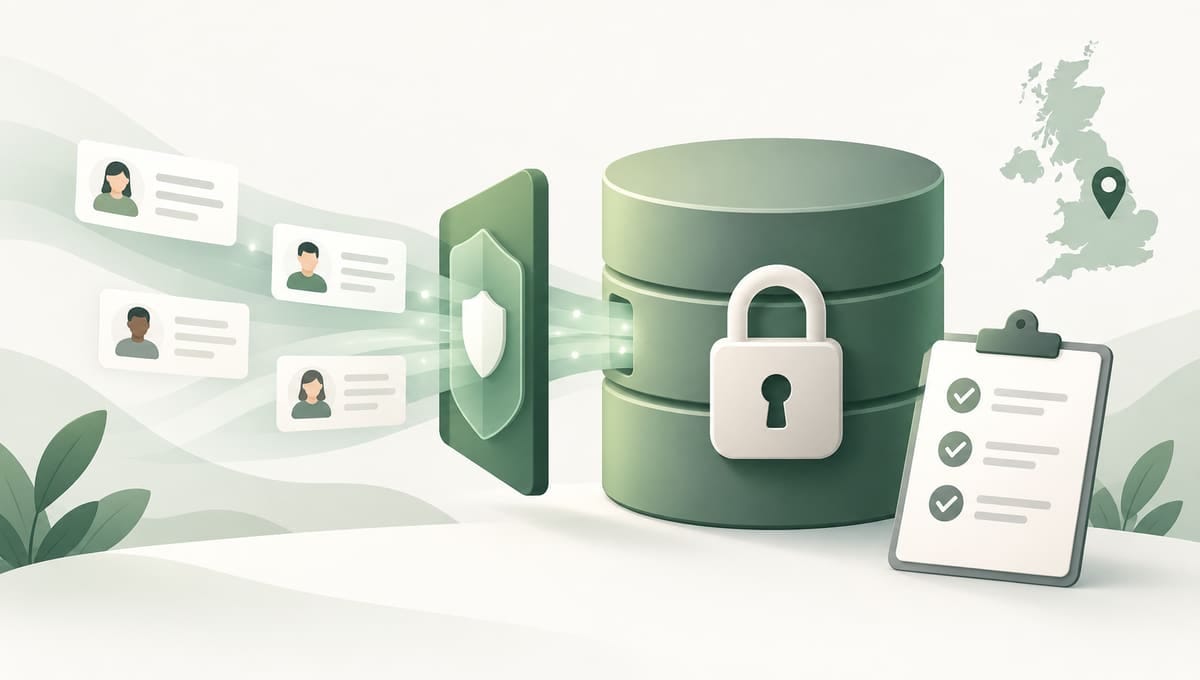
What does UK GDPR mean for sending user data to a model provider?
Once personal data goes into a prompt, the provider processes it on your behalf. The basics:
- Put a data processing agreement in place with each provider, plus a valid transfer mechanism if they process outside the UK, as most do.
- Name each provider in your privacy notice, and send only what the job needs.
- Know the defaults: neither OpenAI nor Anthropic trains on API data by default, both keep it for no more than 30 days, and both offer zero data retention to customers they approve.
- If the AI decides things about people, such as hiring or credit, take specific advice: automated decision-making has its own rules.
The data section of open-source LLMs vs OpenAI & Anthropic compares more providers. This is general guidance, not legal advice.
How long does it take to build an AI SaaS MVP?
A production AI MVP takes 10–14 weeks with a small senior team; a validation build of one AI workflow can ship in 2–4. The weeks beyond a standard 8–12 week MVP go on evals, prompt iteration and guardrails. A 12-week build:
| Weeks | Focus | By the end you should have |
|---|---|---|
| 1–2 | Discovery and eval set | The one-sentence job, 50–100 real examples with pass/fail rules, data model, designs |
| 3 | Prompt prototype | A frontier-model prompt scored against the evals; go/no-go |
| 3–4 | Foundations | Auth, Postgres, provider layer, job queue and deploys working |
| 5–8 | Core AI workflow | Input → background job → validated output → review screen, every call logged and costed |
| 9–10 | Guardrails and limits | Injection and edge-case tests, human review, plan limits, billing |
| 11–12 | Pilot and launch | Evals re-run on fresh examples, design-partner pilot, monitoring, launch |
Integrations, large document sets or regulation push towards 14 weeks; one narrow workflow lands nearer 10.
A 2–4 week validation build is one AI workflow, one type of user, a small eval set and a light backend: enough to learn whether real users would pay. It isn't ready for the public; limits, review flows and hardening are what the other weeks buy. Our guide to building a SaaS MVP in 3 weeks covers what short builds hold.
What tech stack is best for an AI SaaS MVP?
The same proven stack as any SaaS MVP, plus a job queue, pgvector and a provider layer: AI changes three layers, not the architecture.
| Layer | Our default | Why it suits an AI MVP |
|---|---|---|
| App and API | Next.js + TypeScript | Model calls run server-side, keeping API keys out of the browser |
| Database | Postgres on Supabase + pgvector | Embeddings sit beside the tenants and permissions they belong to |
| Auth | Clerk | Organisations built in; a user ID for each call's cost |
| Payments | Stripe | Subscriptions now, usage-based pricing when heavy users need it |
| Background jobs | Inngest or Trigger.dev | Long model calls run off the request path, with retries |
| Model | Frontier API behind a provider layer | Set the quality bar, then route tasks to cheaper models |
| Product analytics | PostHog | Which outputs users accept or edit, plus per-call tokens, cost and latency |
The queue is the layer founders skip. Inngest saves each completed step's result, so a failed step retries without re-running a model call that succeeded. Trigger.dev runs have no built-in maximum duration, and concurrency keys cap each user's simultaneous jobs.
How much does an AI SaaS MVP cost?
Two numbers matter: the build and the running cost per user. What it costs to build an AI app breaks the build down by app type. Our fixed prices start from £5K for validation prototypes, £15K for production SaaS MVPs and £20K for AI MVPs.
Running cost is where AI-native products differ. As of October 2026, Claude Sonnet 5.5 and GPT-6.1 Sol cost $2 per million input tokens and $10 per million output; Claude Haiku 5.5 and GPT-6 Luna cost $0.10 and $0.50. Vendors change pricing often. A job sending 5,000 tokens and getting 1,000 back costs 2 cents on the mid-tier, a tenth of a cent on the small tier. At 200 jobs a month that's $4 or $0.20 per user; a power user running 2,000 on the mid-tier costs $40. Price for the heavy user.
Why do AI MVPs fail?
- No evals. Quality becomes a feeling, and each prompt fix quietly breaks something else.
- Demo-driven development. The prompt is tuned on five examples that shine in a pitch; customers bring everything else.
- Unbounded per-user cost. With no limits, one power user or a looping script can cost more than their subscription.
- Hallucinations in customer-facing output. An invented clause or figure reaches a customer unchecked against the source.
- Prompt injection. Emails, uploads or web pages the model reads can carry instructions it follows. The OWASP Top 10 for LLM applications ranks it first, and lists unbounded consumption too.
No filter reliably stops injection, so limit the damage: give the model no permissions the user lacks, and keep a human approving anything it would send or change.
What should you ask an agency building your AI MVP?
Start with our questions to ask a software development agency, then add these:
- How will we know the AI is good enough? An eval set of your real examples, built first and re-run on every change.
- What will an active user cost in model fees, and how is it capped? A per-user cost model and limits in code.
- Which providers see our users' data, and what do they keep? Names, retention defaults and agreements.
- What happens when the model is wrong? Structured outputs, source checks and human review.
- How do you handle prompt injection? "The prompt says ignore attacks" isn't an answer.
- Who owns the code, prompts and eval set? You, in your repository, from the first commit.
- What if a provider raises prices or retires a model? An eval run, not a rewrite.
Our default: how we build AI-native MVPs
For the AI-powered SaaS products we build, the eval set comes first: in discovery we collect your real examples, agree pass/fail rules and prototype on a frontier model, so if the model can't do the job you hear it in week three, not at launch.
The rest is our standard stack, Next.js and Postgres on Supabase with Clerk, Stripe and Resend on Vercel and PostHog for product analytics, plus pgvector, a queue and a provider layer. Every call is costed per user, code and prompts live in your GitHub, and a dedicated PM runs the engagement. We deviate only for concrete reasons, such as a required processing region.
AI MVPs start from £20K and typically take 10–14 weeks, quoted fixed-price after a free scoping call; our SaaS MVP development page lists the packages.
Frequently asked questions
Can an agency build an LLM-powered SaaS MVP in two to four weeks?
A validation build, yes; a production AI product, no. In two to four weeks a small team can put one AI workflow, tested against a small eval set, in front of real users. Usage limits, review flows, injection testing and billing don't fit. If an agency promises them in a month, ask what was cut.
Can you build a production-ready AI SaaS for under $10,000?
Not one you'd want strangers paying for. Under $10,000 buys a validation build, and ours start from £5K: the right way to learn whether the AI does the job before spending more. A production AI MVP needs evals, guardrails, cost controls, billing and monitoring; ours start from £20K.
Do you need to fine-tune a model for an AI MVP?
Almost never. A well-prompted frontier model, with retrieval when the job needs your customers' documents, covers most MVPs. Fine-tuning earns its place once real usage shows a gap prompting can't close, and your eval set will show it.
Want an AI MVP scoped around a job the model can do?
Bring the job you want the AI to do and a few real examples. We'll tell you whether it needs a validation build or a production MVP and what each user will cost to run, then send a scope and a price you can hold us to. Book a free scoping call, or see how our fixed-price builds work first.
Keep reading


Leave a comment