


Strategy
No-Code vs Custom Development for an MVP
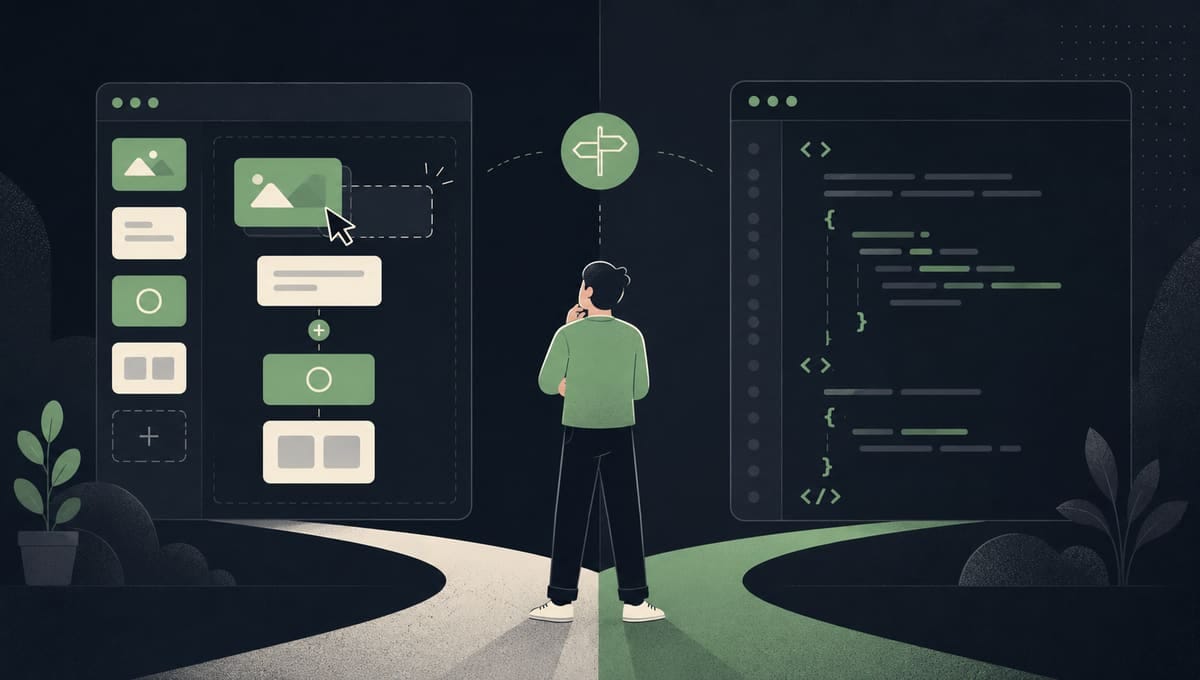
Every founder deciding how to build their first product hits this fork: spend a few weekends in Bubble or Webflow, or spend £15,000+ with a development team. The no-code camp says custom code is a waste of money pre-validation. The agency camp says no-code is a toy you'll rebuild anyway. Both are right — for different products. Here's how to tell which one yours is, from a studio that makes its money on the custom side and will still tell you when not to hire us.
Should you build your MVP with no-code or custom code?
Build with no-code if your MVP is a standard CRUD app whose only job is to test demand; build custom if your core feature is technically distinctive, if you're handling money or sensitive data at any scale, or if the MVP is meant to become the actual product. No-code gets you live in days for £0–£5,000. Custom code starts around £15,000 and takes 8–12 weeks — but it's the version that survives contact with real growth.
The honest framing: this isn't a quality contest, it's a question about what you're actually building. A landing page with a waitlist, a marketplace directory, a booking tool, an internal ops dashboard — no-code handles all of these well, and paying an agency to build them is usually the wrong call. A product whose core value is the software itself — an algorithm, an AI feature, a workflow no template anticipates — is a different animal.
No-code vs custom code at a glance
| No-code (Bubble, Webflow, Glide) | Custom code | |
|---|---|---|
| Typical cost | £0–£5,000 DIY; £5,000–£15,000 with a no-code agency | From £15,000 for a production MVP |
| Speed to launch | Days to 3 weeks | 8–12 weeks |
| Scalability | Fine to low thousands of users, then platform limits bite | Scales with standard engineering work |
| Lock-in | High — your app lives inside the platform | None — you own the code and can host anywhere |
| Customisation | Great within the template; painful outside it | Unlimited |
| When it breaks | Complex logic, heavy data, integrations the platform doesn't support | Only when you under-invest in the build |
| Due diligence / acquisition | A known red flag for technical investors | A normal asset |
When is no-code enough?
More often than agencies like to admit. No-code is genuinely the right answer when:
- You haven't validated demand yet. If the question is "will anyone sign up?", a Webflow page with a Stripe payment link answers it for under £500. Building anything more first is the classic mistake we cover in why SaaS MVPs fail — founders build before they've proven anyone wants the thing.
- Your product is standard CRUD. Forms in, records stored, lists out, email notifications. Bubble does this well. A directory, a job board, a simple booking system — these are solved problems and no-code solves them.
- You're pre-revenue and the budget is genuinely £0–£5,000. A scrappy Bubble MVP that gets you ten paying customers beats a custom build you can't afford. Revenue from a no-code MVP is also the best possible input to a later custom build.
- It's an internal tool. Ops dashboards, approval flows, admin panels — lock-in and scale barely matter, so no-code's speed wins outright.
If you're in one of these buckets, be suspicious of anyone quoting you £20,000. Including us.
When does no-code break?
Predictably, and usually around the same points:
- Complex or distinctive logic. The moment your core feature isn't a form and a list — matching algorithms, pricing engines, AI features, multi-step workflows with branching state — you're fighting the platform instead of building the product. Workarounds stack up until each new feature takes longer in Bubble than it would in code.
- Performance at modest scale. Bubble apps commonly slow down in the low thousands of active users. You can optimise, but you're optimising someone else's abstraction with limited levers.
- Data you're accountable for. Health data, financial data, anything with serious compliance requirements — you need control over where data lives and how it's secured, and platform hosting limits what you can promise.
- Integrations off the beaten path. Stripe and Mailchimp are fine; the niche industry API your product depends on probably isn't, and building around missing integrations is where no-code budgets quietly die.
- The rebuild tax. This is the one founders underweight. A successful no-code MVP doesn't migrate — it gets rebuilt from scratch, typically at full custom-MVP cost, while your live product keeps running on the old platform. That's not wasted money if the no-code version proved the business. It is wasted money if you knew on day one the product would need custom code by month six.
A useful test: describe your core feature to a developer. If their reaction is "that's just forms and tables," no-code will carry you a long way. If it's "interesting, how does that work?" — the interesting part is exactly what no-code can't build.
What does each option cost?
No-code: £0–£5,000 if you build it yourself — platform fees run roughly £25–£100 a month, and the real cost is your evenings for a few weeks. Hiring a no-code agency runs £5,000–£15,000, which is worth pausing on: at the top of that range you're inside custom-build territory while keeping all of no-code's ceilings and lock-in.
Custom: production-ready MVPs start around £15,000 in the UK and run to £35,000+ depending on scope — the full band-by-band breakdown is in our UK MVP cost guide. That buys real authentication, a real database, code in your own GitHub, and a product that scales with normal engineering rather than platform workarounds. We publish fixed prices for exactly this reason: the comparison only works if the custom number is a known number, not an hourly guess.
On time: no-code ships in days to three weeks; a custom MVP takes 8–12 weeks — see how long an MVP takes to build for the week-by-week reality. If speed-to-learning is the whole game right now, that gap alone can justify no-code.
The hybrid path most founders should consider
The strongest play is often sequential, not either/or:
- Validate with no-code — a landing page, waitlist, or concierge version. Weeks, not months; hundreds of pounds, not thousands.
- Get evidence — signups, pre-orders, ideally revenue.
- Go custom once the evidence is in — now the £15,000+ is a bet on a validated product, and the no-code version keeps trading while the real one is built on a stack chosen to last, like the one in our 2026 SaaS MVP stack.
This sequence spends the least money at the point of highest uncertainty and the most money after the uncertainty is gone. If you're unsure which side of the line your idea falls on, that's a product strategy question, and it's cheaper to answer before either build starts.
One boundary worth naming: this article is about the build method. If you've decided on custom and are now choosing who builds it, that's a different decision — covered in agency vs in-house for your MVP, do you need a technical co-founder and how to choose a development agency.
Frequently asked questions
Can a no-code MVP scale to real users?
Yes — to a point, typically the low thousands of active users for a Bubble app, after which performance and platform limits force a rebuild. Plenty of real businesses run on no-code longer than the stereotype suggests, and some never leave. But scaling past the platform's ceiling isn't an optimisation exercise; it's a rewrite. If your model depends on tens of thousands of users, treat no-code as a validation tool, not the product.
Do investors care if my MVP is built with no-code?
At pre-seed, almost never — traction is the only thing that matters; at seed and beyond, a no-code product raises questions about defensibility and the cost of the rebuild. A no-code MVP with revenue beats a custom MVP with none, every time. What changes later is technical due diligence: investors will price in the migration, and if your moat is supposedly the technology, "it's a Bubble app" undermines the story. Raise on the traction, then build the asset.
How much does it cost to rebuild a no-code MVP in custom code?
Roughly the same as building custom from scratch — from about £15,000 for a production MVP — because code doesn't migrate out of no-code platforms; only the learning does. You're not porting an app, you're rebuilding a validated one, which is genuinely faster and safer than building an unvalidated one: the scope is proven, the workflows are known, and the data model has been stress-tested by real users. Budget for it as a full build, just one with far less risk.
Is Bubble good enough for a SaaS product?
Bubble is good enough for a standard-workflow SaaS with a modest user base — and a poor fit the moment your core feature is algorithmic, data-heavy, or compliance-sensitive. If your SaaS is forms, records, dashboards, and Stripe, Bubble can carry you to first revenue and beyond. If the product's value is in what the software computes rather than what it stores, you'll hit the ceiling early, and every month on the platform adds to the rebuild bill.
The bottom line
No-code and custom code answer different questions. No-code answers "does anyone want this?" for £0–£5,000 in weeks. Custom code answers "can this become a real company?" from £15,000 in a couple of months. The expensive mistake isn't picking either one — it's paying custom prices to answer the first question, or trusting a no-code stack to answer the second.
Not sure which side of the line your product sits on? Book a free 30-minute scoping call — we'll tell you straight whether your MVP needs custom code or whether a £500 no-code weekend will do the job, and if it's the latter, we'll say so and point you at the right tools.
Keep reading



Leave a comment