


Pricing
How Much Does an App Cost to Build in the UK?
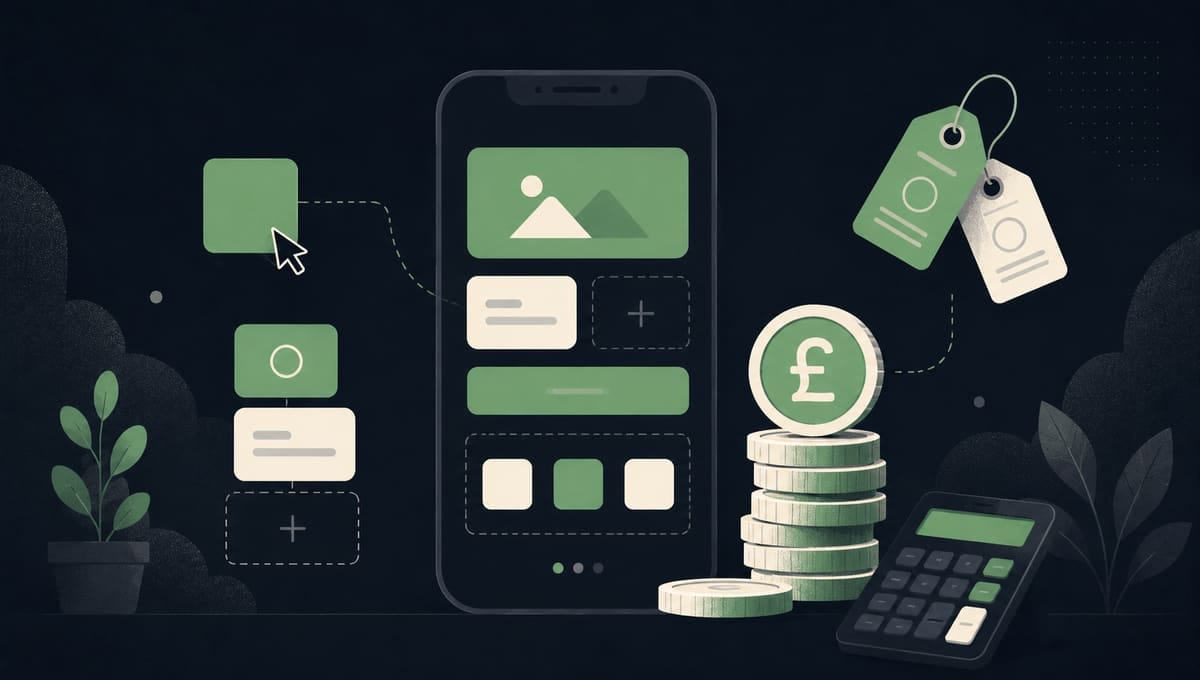
Ask five UK agencies what an app costs and you'll get five numbers spanning £8,000 to £200,000 — all technically honest, because "an app" can mean a one-screen utility or a two-sided marketplace with payments. This guide is specifically about mobile apps — iOS and Android — and gives you the real price bands, what moves the number, and the running costs most founders forget to budget.
How much does it cost to build an app in the UK?
Most UK mobile apps cost between £15,000 and £60,000 to build in 2026 — a simple utility app starts around £10,000–£20,000, a standard MVP with a backend runs £15,000–£35,000, and complex marketplace or enterprise apps sit at £40,000–£80,000+. The spread comes from scope, backend complexity, and whether you need one platform or two — not from where the agency is based or how nice its office is.
At UK agency day rates of £600–£1,200, an app's cost is essentially the number of senior-team weeks it takes to design, build, and ship. A four-screen app with no accounts is a few weeks of work. A marketplace with two user types, payments, and notifications is several months. That's the whole pricing model, demystified.
App development cost by type
Here's where the common categories of app land in the UK in 2026 — the same bands we quote against on our pricing page:
| App type | Typical UK cost | What it includes |
|---|---|---|
| Simple utility app | £10K–£20K | 3–6 screens, no accounts or a light backend, one core job done well |
| MVP with backend | £15K–£35K | Accounts, real database, push notifications, one or two integrations, both stores |
| Marketplace / two-sided app | £40K–£80K+ | Two user types, payments and payouts, messaging, reviews, admin tools |
| Enterprise-grade app | £80K–£150K+ | SSO, compliance, offline sync, legacy integrations, formal QA and support |
Two things worth noticing. First, the jump from "MVP" to "marketplace" is the steepest in the table — a two-sided app is really two apps sharing a backend, plus payments infrastructure that has to move money correctly. Second, the bands overlap because scope matters more than category: a ruthlessly scoped marketplace can cost less than a bloated utility app.
If what you're actually building is a web-based SaaS product rather than a mobile app, the economics are different — see our UK MVP cost breakdown instead. And if you're adding AI features to the app, there's an extra cost dimension (per-use API bills) we cover in how much an AI app costs to build.
What drives the cost up?
Mobile apps have cost levers that web products don't. These are the ones that move the quote the most.
The backend is usually half the build
Founders budget for the app they can see and forget the server they can't. Accounts, data storage, push notification delivery, payments, and admin tools all live in a backend — and for most apps that's 40–60% of the total cost. An app that works entirely on-device is dramatically cheaper than one that syncs.
Two platforms, two review processes
Shipping to both the App Store and Google Play means two sets of store guidelines, two review queues, two release pipelines, and testing across a zoo of devices and OS versions. Cross-platform frameworks (more below) contain this cost, but they don't eliminate it — store setup, review fixes, and device testing are real work regardless of stack.
Design depth and platform polish
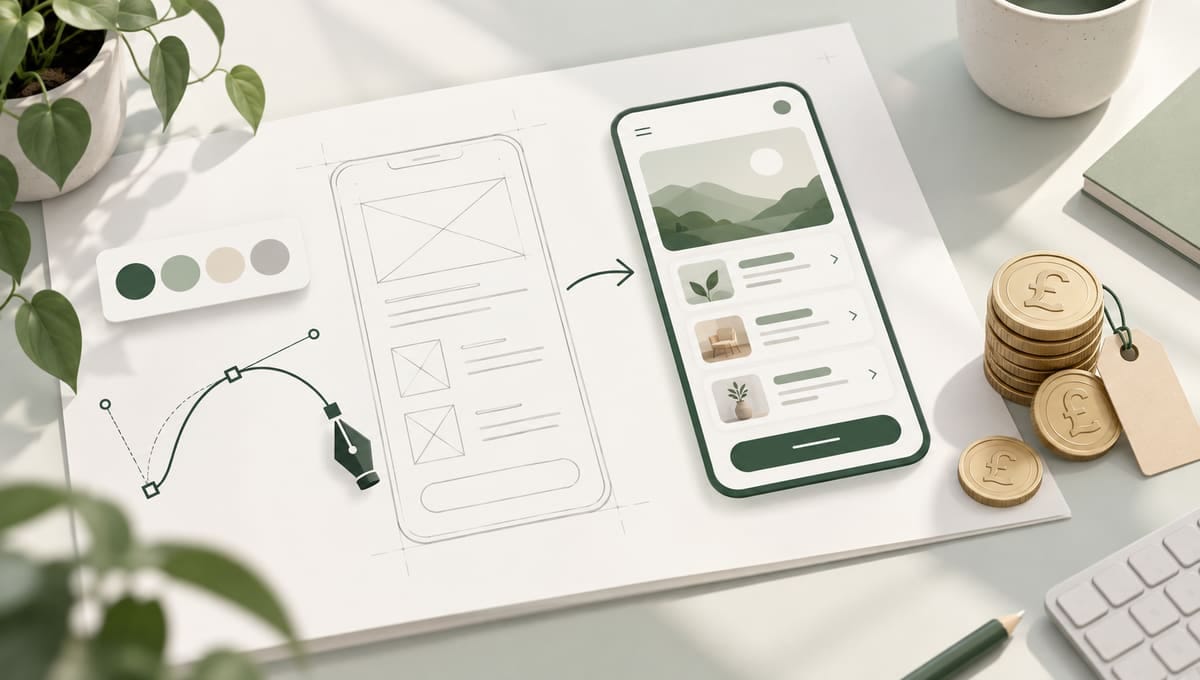
A functional app using standard iOS and Android components is far cheaper than a bespoke, animated, brand-led experience. Custom design language, micro-interactions, and pixel-perfect parity across platforms can add £5,000–£15,000 on their own. For a first version, clean-and-native usually beats beautiful-and-bespoke. Our guide to UI/UX design costs in the UK prices the design work on its own.
The features that quietly double budgets
- Payments — Stripe checkout is cheap; marketplace payouts, subscriptions, and in-app purchases (with Apple's rules) are not
- Chat and real-time features — sockets, presence, and message history add a whole subsystem
- Offline mode — sync and conflict resolution is one of the hardest problems in mobile
- User-generated content — moderation, reporting, and storage costs arrive with it
The pattern behind all of these: cut anything that doesn't test your core idea. Every feature costs money three times — to design, to build, and to maintain forever after.
Is cross-platform cheaper than native?
Yes — for most startups, meaningfully so. Building separate native apps in Swift and Kotlin means two codebases, two skill sets, and close to double the engineering time. A cross-platform framework gives you one codebase that ships to both stores, typically saving 30–40% versus dual-native while keeping near-native performance for the vast majority of app types.
In practice, that's how most UK startup apps are built in 2026, and it's how we build them in our app development service. The real decision is which framework — we break down the trade-offs in our React Native vs Flutter comparison. The short version: both are production-grade; your choice should follow your team's existing skills and your app's specific needs, not benchmarks.
When does native still win? Games, heavy AR, advanced camera or sensor work, and apps where the last 5% of platform polish is the product. If that's not you, cross-platform is the pragmatic default.
What about running costs?
The build is a one-time cost. An app in the stores generates bills forever, and founders who budget £25,000 for the build and £0 for year one running costs get an unpleasant surprise. Plan for:
- Developer accounts — Apple charges £79/year, Google a one-off £20
- Hosting and backend — typically £20–£200/month at MVP scale, rising with users
- Third-party services — push, analytics, crash reporting, email; often free tiers early, then £50–£300/month
- OS updates — Apple and Google ship major versions yearly, and apps that aren't updated eventually break or get delisted
- Maintenance and small fixes — a sensible rule of thumb is 15–20% of the build cost per year to keep the app healthy
A £25,000 app, in other words, is realistically a £25,000 build plus £4,000–£6,000 a year to keep it alive and improving. Bake that into your runway maths before you start, not after launch.
Frequently asked questions
Can you build an app for £5K?
Not a production app — but £5K–£10K buys a high-fidelity prototype that validates demand before you spend the real money. For that budget you get a clickable, realistic version of the core flow you can put in front of users and investors. What you can't get is accounts, a backend, store approval, and the testing a live app needs. If a £5K prototype kills a weak idea, it just saved you £30K; if it validates a strong one, nothing is wasted — the design work carries into the full build.
How long does an app take to build?
A simple app takes 6–8 weeks, a standard MVP 10–14 weeks, and a marketplace or enterprise app 4–6 months. App Store review adds a few days to a week at the end, and a first submission sometimes bounces once before approval — so never promise a hard launch date that assumes zero review friction. The timeline drivers are the same as the cost drivers; for the week-by-week view, see how long it takes to build an MVP.
What does app development cost for a startup?
For a UK startup shipping a first version, budget £15K–£35K for the build plus 15–20% of that per year in running costs. The way to stay at the bottom of that range is scope discipline: one core flow, cross-platform codebase, standard components, and payments or chat only if they're the product. The way to blow past the top of it is "while we're at it" features — each one feels small and none of them are.
Do I need both iOS and Android at launch?
Usually yes in the UK — iOS and Android each hold roughly half the market, so launching on one halves your addressable users. This is exactly why cross-platform frameworks dominate startup builds: both stores from one codebase at little extra cost. The exception is a narrow audience you know skews one way — a premium consumer product might justifiably start iOS-only.
The bottom line
A UK mobile app costs £10K–£20K for something simple, £15K–£35K for a proper MVP, and £40K–£80K+ for a marketplace or enterprise build — plus 15–20% a year to keep it running. The number is driven by scope, backend complexity, and platform coverage, and the single best way to control it is to cut the feature list, not the quality of the team building it.
Want a real number instead of a range? Book a free 30-minute scoping call and we'll give you a fixed price and timeline for your specific app — before you commit a penny.
Keep reading

Leave a comment