

Strategy
MVP vs Prototype vs POC: What to Build First
Founders use "MVP," "prototype," and "proof of concept" as if they were the same thing. They are not — and building the wrong one first is one of the most expensive mistakes you can make before you have written a line of production code. Each answers a different question, costs a different amount, and is shown to a different audience. Get the choice right and you validate the riskiest part of your idea for the least money.
What's the difference between an MVP, a prototype, and a POC?
A proof of concept asks "can this be built?", a prototype asks "does this feel right?", and an MVP asks "will people actually use — and pay for — this?" — they move from technical feasibility, to user experience, to real market validation. A POC is a throwaway technical test, a prototype is a clickable mock-up with no working backend, and an MVP is a real, shippable product that does one valuable thing end to end.
The confusion is understandable — all three are "smaller than the full product." But they are not points on a single line. They answer different questions, and the one you need depends entirely on where your biggest risk sits.
POC vs prototype vs MVP at a glance
| Proof of concept (POC) | Prototype | MVP | |
|---|---|---|---|
| Question it answers | Can this be built? | Does this flow feel right? | Will people use and pay for this? |
| Audience | You and your engineers | Users, testers, your team | Real, paying customers |
| Fidelity | Throwaway code / script | Clickable mock-up, no real backend | Production-grade, live product |
| Cost (UK) | Often free–£3K | ~£3K–£5K | From £15K |
| Timeline | Days to 2 weeks | 1–3 weeks | 8–12 weeks |
| What you learn | Technical feasibility | Usability + desirability | Market demand + willingness to pay |
What is a proof of concept (POC)?
A proof of concept is a small, throwaway build whose only job is to prove a specific technical risk can be solved. It is not shown to customers, it is not pretty, and it is usually deleted afterwards.
You need a POC when the core question keeping you up at night is "is this even possible?" — not "will people like it?" Typical triggers:
- Can we sync two systems whose APIs were never meant to talk to each other?
- Can our matching algorithm return a result in under 200ms at realistic scale?
- Can we extract clean structured data from these messy PDFs?
- Will this AI model give reliable-enough answers for our use case?
A POC is deliberately narrow. It ignores authentication, design, edge cases, and everything else — it exists to answer one yes/no technical question as fast as possible. In the UK a POC is often something an engineer spikes in a few days, so the cost is small (often just internal time, or a few thousand pounds if you bring in a specialist). Critically, a POC is not a foundation you build on. The code is a probe, not a first draft. Reusing throwaway POC code as your production base is a classic way to inherit shortcuts you will pay for later.
What is a prototype?
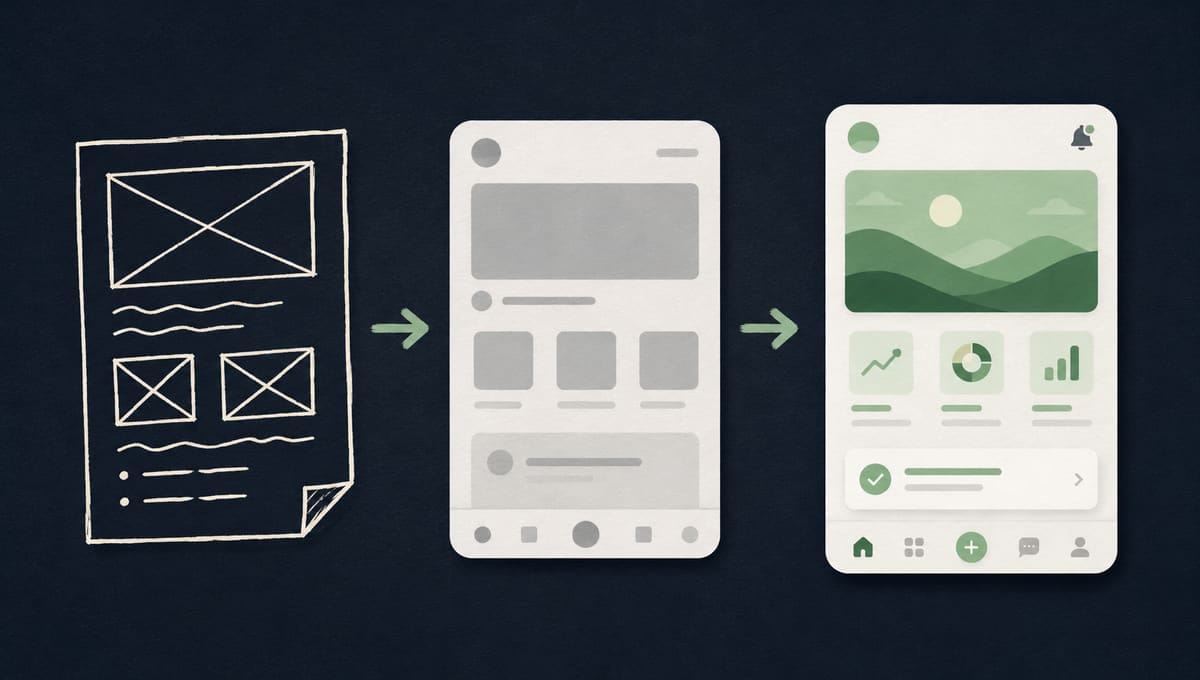
A prototype is an interactive mock-up of the user experience — usually clickable screens with no real backend — built to test whether the flow makes sense before you build it for real. It looks like a product but does not actually do anything under the hood.
Most prototypes today are built in a design tool like Figma: real screens, real navigation, tappable buttons, but the data is faked and nothing is saved. You put it in front of five or ten target users, watch where they hesitate, and learn whether your intended flow is obvious or confusing — for a fraction of the cost of building it.
A prototype answers questions a POC cannot:
- Do users understand what this product is within five seconds?
- Is the core workflow intuitive, or does it need explaining?
- Which of two layouts do people navigate more confidently?
- Does the value proposition land before they lose interest?
A focused validation prototype in the UK typically runs around £5K and takes one to three weeks. That is money well spent when your biggest risk is desirability — whether people want the thing and can figure out how to use it — rather than whether it can be built. A prototype de-risks the design before you commit engineering budget. What it cannot tell you is whether people will pay, because nothing is real enough to charge for.
What is an MVP?
A minimum viable product is a real, working, production-grade product that does one valuable thing end to end — the smallest version you can actually put in front of paying customers to test real demand. Unlike a prototype, an MVP has a real backend, real data, real accounts, and is deployed for real users.
This is the crucial line: an MVP is shipped, a prototype is shown. An MVP has authentication, a database, a deployed environment, and at least one complete workflow a stranger can sign up and use without you sitting next to them — usually built on the best tech stack for a SaaS MVP. It is narrow on purpose — one core workflow at production quality, not a feature-complete platform. For the full anatomy, see our breakdown of what's actually in a £15K SaaS MVP, and if you want to know how to trim scope to fit, read how to scope a SaaS MVP in 8 weeks.
An MVP is the only one of the three that can validate the question that actually matters for a business: will people pay for this? A prototype can tell you people like the idea; only a live product with a real "buy" or "sign up" button tells you they will act on it. Because it is production software, it is also the most expensive of the three — UK MVPs start from £15,000 and ship in 8–12 weeks. (We cover the full range in how much an MVP costs in the UK.)
Which should you build first?
Build the one that attacks your single biggest risk — technical, experiential, or market — because validating the wrong risk cheaply is still wasted money.
Work through it in order:
-
Is your biggest unknown "can this be built at all?" Start with a POC. There is no point designing screens for a feature that may be technically impossible. This is common for AI, hardware-adjacent, or heavy-integration products.
-
Is the technology proven but the experience uncertain? Skip the POC and build a prototype. If similar products already exist and your risk is whether users will get it, a £5K clickable prototype answers that far cheaper than code.
-
Are you confident it can be built and that people want it — you just need to prove they will pay and use it? Go straight to an MVP. Most SaaS founders whose idea uses well-trodden technology fall here, and a POC or prototype would just delay the real test.
The honest truth for most SaaS ideas: the technology is not the risk. The market is. In that case a POC and even a standalone prototype can be a detour — a well-scoped MVP (which includes a design/prototype phase anyway) gets you to real evidence faster. The mistake is spending three months on a beautiful prototype nobody would have paid for, or a POC for a problem that was never in doubt. Building the wrong artefact is one of the most common ways first products stall — see why SaaS MVPs fail and the mistakes to avoid.
If you are unsure which risk is biggest, that is exactly what a product strategy conversation is for: naming the real unknown before you spend a penny building.
Frequently asked questions
Do you need a POC before an MVP?
No — only if your MVP depends on unproven technology. If your product uses standard, well-established tools (the case for most SaaS), a POC just adds weeks; go straight to scoping the MVP. Reserve POCs for genuine technical unknowns like novel AI behaviour or fragile third-party integrations.
Is a prototype the same as an MVP?
No — a prototype is a clickable mock-up you show people, while an MVP is a real product you ship to paying users. A prototype has no working backend and cannot process a real transaction; an MVP is production software with accounts, data, and a live deployment. A good MVP build includes a prototype as its design phase, but the prototype alone is not an MVP.
How much does a prototype cost?
A focused validation prototype in the UK typically costs around £5,000 and takes one to three weeks, versus £15,000+ and 8–12 weeks for a production MVP. A pure technical POC can be cheaper still — often just a few days of engineering time. You can see the full picture on our pricing page, and standalone design work is broken down in UK UI/UX design pricing.
Can one artefact replace all three?
Often, yes — a well-scoped MVP folds the design/prototype step into its first phase, so you rarely need a standalone prototype and an MVP. Standalone POCs and prototypes earn their keep when a specific technical or usability risk is large enough to validate before committing to a full build.
The bottom line
A POC proves it can be built, a prototype proves the experience feels right, and an MVP proves people will use and pay for it. They are three different tools for three different risks — not three sizes of the same thing. Pick the one that attacks your biggest unknown first, and do not spend MVP money answering a POC question, or POC time on a market you could have tested with a live product.
Not sure which your idea needs? Book a free 30-minute scoping call and we will name your biggest risk and the cheapest way to validate it — before you build anything.
Keep reading



Leave a comment