



Engineering
Clerk vs Better Auth for B2B SaaS (2026)
B2B auth rarely breaks at the sign-in form. It breaks at everything around it: the organisation switcher, the invite flow, the customer who wants a custom role, and the enterprise prospect whose IT team won't sign without SAML. Clerk sells you that layer finished; Better Auth hands you an open-source library and your own tables. This is the focused two-way B2B comparison — for the wider field, including Auth0 and Supabase Auth, see Clerk vs Auth0 vs NextAuth.
Clerk or Better Auth: which should a B2B SaaS use?
Use Clerk if you want organisations, invitations, MFA and SSO working in days and can live with per-user and per-organisation pricing; use Better Auth if you need user records in your own database, expect thousands of low-revenue customer accounts, or must self-host for data residency. In 2026 both cover nearly all of the B2B checklist — the real difference is who builds the screens and who holds the data.
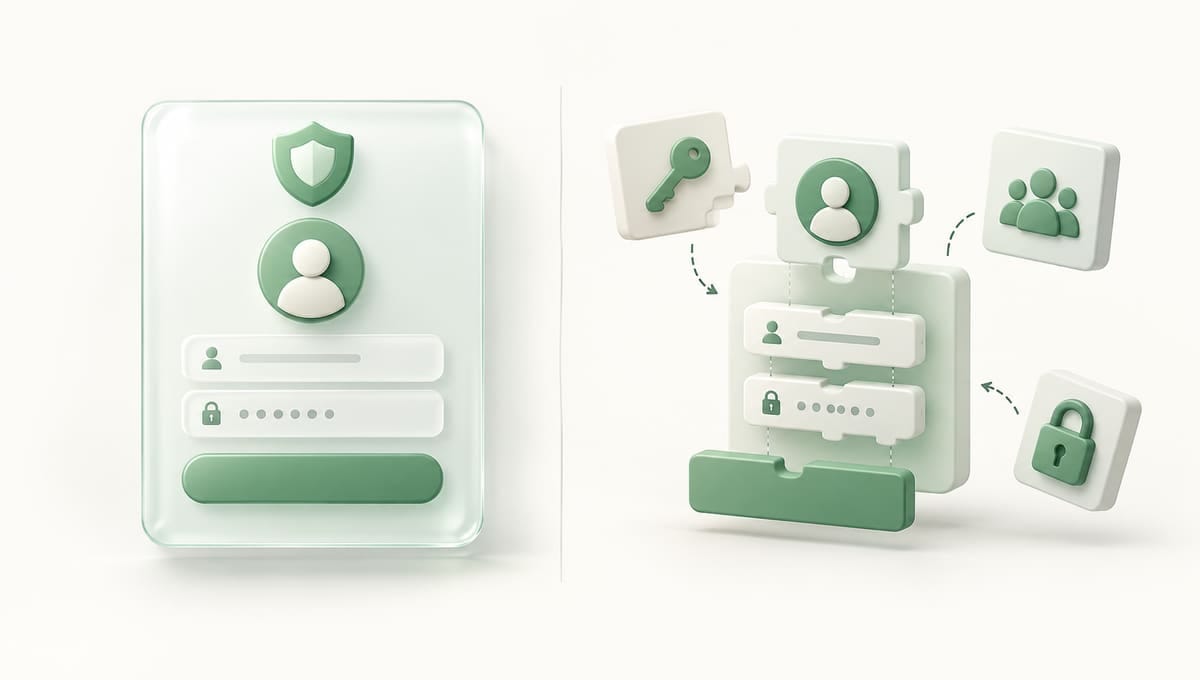
Clerk is a hosted service with polished prebuilt components for sign-in, profiles and organisation management. Better Auth is an MIT-licensed TypeScript framework that runs inside your app and writes to your own Postgres; its plugins cover organisations, SSO, SCIM, MFA and passkeys, but the interface is yours to build.
The B2B checklist, side by side
| Clerk | Better Auth | |
|---|---|---|
| Organisations / teams | Built in; free for 100 active orgs of up to 20 members | Organization plugin, with optional teams inside each org |
| Roles & permissions | Admin and Member with custom permissions; custom roles need the B2B add-on | Owner, admin, member by default; custom roles in code or created at runtime |
| Invitations | Built in, emails sent for you; verified domains and auto-join on the add-on | Built in; you send the email |
| SSO / SAML | SAML and OIDC; 1 connection on Pro, then $75/month each | SSO plugin with SAML 2.0 and OIDC, free; self-service setup is a paid extra |
| SCIM / directory sync | 1 connection on Pro, then $75/month each | SCIM plugin, free |
| MFA | Authenticator app, SMS and backup codes, Pro and up | Two-factor plugin: TOTP, email or SMS codes, backup codes |
| Passkeys | Pro and up | Passkey plugin (WebAuthn) |
| Impersonation | 5 a month free; unlimited on a $100/month add-on | Admin plugin, unlimited |
| Audit logs | Application logs, 1–30 days' retention by plan; admin audit trail on Business | Paid Infrastructure add-on, or build your own |
| Session management | Device list and revocation on all plans; custom lifetimes on Pro | List and revoke sessions in core; multi-session plugin |
| UI | Prebuilt sign-in, profile, org switcher and org management | None in core; build it, or use the separate Better Auth UI project |
| Where users live | Clerk's database; sync to yours via webhooks | Your database, your tables |
Clerk's B2B strength is the interface. Its best B2B features — the organisation switcher, member management, invitations and role assignment — arrive as working components wired to the session your middleware checks. The catch is in the tiers: MFA and passkeys need Pro, while custom roles, verified domains and linking an SSO connection to a customer's organisation all sit in the Enhanced B2B add-on. Your first enterprise customer usually means buying it.
Better Auth's strength is coverage without a meter. The SSO plugin speaks SAML and OIDC, the SCIM plugin accepts provisioning from a customer's directory, and the admin plugin handles impersonation — none of it priced per connection or per user. What it lacks is the screen your customer's IT admin uses to configure their own SAML connection: the plugin registers providers through its API, and self-service setup is a paid Better Auth feature or yours to build.
Audit logs are a gap on both sides: each records auth events, but an in-product audit trail your customers can browse — "who removed this user?" — is yours to build either way.
What does each cost as you grow?
Clerk's bill grows with retained users, active organisations and SSO connections; Better Auth's licence stays at zero, and you pay in database, hosting and engineering time instead. As of October 2026, Clerk's pricing page lists:
- Hobby: free for 50,000 monthly retained users per app — but no MFA, passkeys or SSO, which rules it out for most B2B products.
- Pro: $25/month ($20 billed annually) with 50,000 retained users included, then $0.02 per user per month, falling with volume. One SSO and one directory sync connection included; extras are $75/month each, with directory sync billing starting 1 January 2027.
- Business: $300/month ($250 annually), adding a SOC 2 report and admin audit logs.
- Enhanced B2B add-on: $100/month ($85 annually) for custom roles, verified domains, unlimited members and SSO linked to organisations.
- Organisations: 100 active per app free; beyond that you need the add-on, then $1/month each, falling to $0.90 above 1,000.
Clerk only counts users who return at least a day after signing up, and organisations with two or more members, one of them active that month. Vendors change pricing often, so treat this as a snapshot. For an illustrative B2B product:
| Stage | Clerk, billed monthly | Better Auth |
|---|---|---|
| MVP: 40 customer orgs, 1,000 users, MFA on | $25 — Pro, for MFA and passkeys | $0 licence; tables in the Postgres you already run |
| Traction: 250 orgs, 5,000 users, 1 SSO customer | $275 — Pro, B2B add-on, 150 extra orgs at $1 | $0 licence; from $20 if you add Infrastructure Pro |
| Scale: 1,000 orgs, 80,000 users, 5 SSO customers | $1,925 — adds $600 of user overage, $900 of orgs and $300 of SSO | $0 licence; from $220 with Infrastructure Pro and self-service SSO |
Better Auth itself is free and open source. Better Auth Inc. also sells an optional add-on, Better Auth Infrastructure, which connects a hosted dashboard, audit logs, security detection, self-service SSO and directory sync to your self-hosted install. Starter is free; Pro is $20/month with one SSO and one directory connection, then $50/month per extra connection, per Better Auth's pricing page. The library works fully without it. Better Auth announced in July 2026 that it is joining Vercel and can now focus on the framework without shaping its strategy around monetisation, so check those plans are current before you budget around them.
What the table can't show is engineering time. With Better Auth, every screen Clerk ships — sign-in, MFA enrolment, organisation switcher, member list, invite acceptance, SSO setup — is one you design, build, test and maintain. That's weeks up front and a permanent line in what it costs to maintain a SaaS.
Who owns your users — and how hard is it to leave Clerk?
With Better Auth, user, session and organisation records are rows in your own database from day one; with Clerk, they live in Clerk's, and your tables hold IDs that point at them. That shows up in three places.
Queries. Anything that needs other users' details — a member list, an
"assigned to" column, a usage report — means calling Clerk's API or keeping a
copy in sync via webhooks (user.created, user.updated, user.deleted).
Clerk's own docs warn that delivery isn't guaranteed and events can arrive late,
out of order or more than once, so the sync code must be idempotent. With Better
Auth, it's a SQL join.
Residency. With Better Auth, auth data sits wherever your database does — a UK or EU region if a buyer insists. With Clerk, it sits on Clerk's infrastructure under its data processing agreement, which most buyers accept and some regulated ones won't. This is general guidance, not legal advice.
Leaving. Clerk lets you export every user from the dashboard as a CSV, hashed passwords included, and Better Auth publishes a Clerk migration guide: configure bcrypt so existing passwords keep working, import the users, and accept that every active session is invalidated. Organisations aren't covered by that guide yet, so memberships, roles and pending invitations are custom migration work. Budget a week or two — a week or two you never spend if you start on your own tables.
What happened to NextAuth (Auth.js)?
Auth.js — formerly NextAuth.js — has been maintained by the Better Auth team since September 2025, and the maintainers recommend Better Auth for new projects. Their announcement says existing Auth.js apps can carry on without disruption, with security patches and urgent fixes continuing, but strongly recommends that new projects start on Better Auth unless they hit a specific feature gap. In July 2026 Better Auth announced it was joining Vercel, with a stated commitment to keeping it open source and framework-agnostic; the code remains MIT-licensed.
So if the open-source NextAuth route in our four-way comparison appealed to you, for a new build read it as Better Auth. Existing Auth.js apps don't need an emergency migration — plan it alongside your next significant auth change.
Our default: Clerk, with Better Auth for specific constraints
For the B2B products we build through our web development work, the default is Clerk on Next.js, alongside Postgres (often on Supabase), Stripe and Resend on Vercel — the stack in our SaaS MVP tech stack guide. The reason hasn't changed: on an eight-week fixed-price build, Clerk's organisation switcher, invitations, MFA and profile screens save two to three weeks of UI work, and weeks are the currency that matters. Clerk's organisation ID becomes the tenant ID on every tenant-owned table, enforced with Row-Level Security as our multi-tenant SaaS architecture guide describes.
We pick Better Auth instead when one of these is true:
- The unit economics don't fit. Thousands of small teams on a cheap plan, where $1 per active organisation plus user overage eats into margin.
- Users need to live in your database. Heavy reporting, complex joins across users and organisations, or a product where identity is core data rather than a login.
- Residency or self-hosting is a requirement. A buyer, regulator or contract needs auth data in a specific region or on infrastructure you control.
- Lock-in is a stated concern. Investors or an acquirer are already asking about vendor dependency in diligence.
If you're already on Supabase, Supabase Auth is still the simplest answer, as the four-way comparison explains. Choosing Better Auth adds the UI weeks back into the build, and we scope and quote it that way.
Frequently asked questions
Is Clerk worth it for B2B SaaS?
Yes, for most early-stage B2B products — the organisation, invitation and MFA screens it ships are weeks of work you skip, for $25 a month until you pass 100 active customer organisations or need custom roles. After that, plan for the $100/month B2B add-on, $1 per active organisation and $75/month for each SSO connection beyond the first. That's trivial when each customer pays hundreds a month and painful when they pay a few dollars. Run the numbers at your target customer count, not today's.
What database should I use with Clerk?
Any — Clerk holds identity, not your application data, so choose on the merits; for B2B SaaS that's usually Postgres. Store Clerk's user and organisation IDs on your own tables and read them from the session token rather than a synced copy wherever you can. Sync users via webhooks only when queries need other users' details. Supabase also supports Clerk as a third-party auth provider: it accepts Clerk session tokens, so RLS policies can check the user's organisation and role claims, with those users billed as third-party MAUs beyond your plan's quota — what that adds to the bill is in Supabase pricing explained.
Keycloak vs Clerk: when does Keycloak make sense?
When you need a self-hosted identity server with deep SAML, OIDC and LDAP support and have the ops capacity to run it — rarely true for an MVP. Keycloak is an open-source (Apache 2.0), Java-based identity server and a CNCF incubation project, and since version 26 its Organizations feature covers B2B multi-tenancy. But it's a separate service you deploy, patch, back up and scale, with login pages built as themes. It earns its keep for on-premise deployments or Active Directory federation; otherwise Better Auth gives you self-hosting inside your own codebase.
What about Auth0 or Firebase Auth?
Auth0 suits enterprise-heavy B2B with procurement-driven SSO requirements; Firebase Auth suits products already built on Firebase. Auth0 is covered in the four-way comparison linked above. Upgrading Firebase Auth to Identity Platform adds SAML (web only), OIDC, MFA and multi-tenancy as separate user silos, but there's no organisation-membership or invitation model — you'd build that yourself. It also pairs most naturally with Firestore rather than Postgres, as our Supabase vs Firebase comparison covers.
Want auth chosen around your buyers, not a default?
The right answer depends on how many customers you'll have, what they pay and what their IT teams will ask for. If you want the auth layer mapped to your real pipeline — including when, if ever, you'll need SSO — book a free scoping call. We'll scope it and quote the build fixed-price, so you know the cost before committing.
Keep reading



Leave a comment